Thursday morning my phone rang while I was pulling out of the driveway.
One of my co-workers was calling to inform me that I hadn't gotten an email on my BlackBerry since 2am because there was some unpleasantness in the data center. I let him know that I was on my way already, while he listed off systems that would be unavailable until the current crisis had been resolved.
In part, our data center relies on the chilled water system in the office building for our cooling. Since Wednesday night was so meterologically nice, building management had switched over to the smaller chiller. That chiller doesn't provide enough water pressure to properly support the cooling for our sealed, glass-walled server area.
To supplement, we have our own AC unit dedicated for that room.
Unfortunately, Wednesday night the breaker for that unit flipped.
In a few short hours, the temperature in the server room rose to over 120 degrees.
Of course, servers started shutting themselves down, including our email (and BlackBerry) server at 2am, which effectively killed even our notification of the temperature spike. However, people noticed when the servers started vanishing from the network, and we were called.
The door was propped open and a fan put in place to exhaust some of the air before the hard drive platters started to be shaped like Pringles.
Any servers that hadn't powered themselves down were turned off to conserve heat, and we watched the thermostat slowly ease below the 99.9 read out that only reflects how hot it can display.
Long-term casualties included the voicemail server. Last I heard, it was still offline. I try to never check my voicemail anyway, as it just establishes an expectation that I would respond to it, but some people seem to actually use that stuff. I have no idea for what.
The rest of yesterday was spent clearing packing materials out of my cubicle in anticipation of the photographers showing up this morning at 10am.
Our CIO is winning an award for CIO-ing, and there is a chance my cubicle might end up in the background of one of the shots.
Aside from my laptop, at the moment my desk only holds my phone, monitor stand, a file organizer and a new yellow legal pad.
Everything else was unceremoniously dumped into an unused file drawer I hadn't noticed until yesterday. I hope none of it was important, but since most of it came with the cubicle there was no way for me to know. That is, there is no way for me to know aside from reading it, I guess, but that is on my to-do list right after checking and responding to my voicemail.
Friday, March 09, 2007


Thursday, March 08, 2007
As promised, I'm going to discuss an online phenomenon and its impact on our IRL lives.
Unfortunately, the phenomenon I've chosen is one which, I suspect, causes some of my less-geeky readers to tune out.
You guys can scroll down to the bottom now. I'll even put in a picture of a kitten to mark the spot where I stop talking about . . . Massively Multiplayer Online Games.
By one easily found estimate, last year MMOs generated over half a billion dollars in revenue.
Initial cost for the games is minor, with an average being somewhere between $20 and $50 for the boxed version.
These retail copies exist not as sources of revenue, but primarily to bring in new gamers. Each subscription grosses the company about $180 per gamer year.
Between 2003 and 2004, the amount of subscribers has increased by 75%. At the same time, more traditional forms of entertainment (movies, record sales and (no joke) live theatre) have remained stagnant or actually declined. In some cases, the decline has prompted the RIAA to sue random people.
I've thought a lot about the appeal of these games. Not being one for self-reflection, I have tried to figure out what the other 15 million people see in them.
The first reason is clearly defined goals. In today's world, people are able to spend literally years wandering from task to task with no real purpose. In some cases, this can be enough and even financially rewarding.
For most of us, we'd like a purpose. Some computer generated guy needs 16 wolf pelts and once your character has collected them for him, he tells you that you are a better person and (in some cases) rewards your character with cash and honor. The to-do list is compelling and mostly planned out in advance. There can be a very real feeling of progress.
The second powerful component is the whole idea of playing at being someone else for a while. In fact, you can even decide what you are good at and what you look like when logged in. I think of this concept as the "Awesome You" effect.
I suspect a good number of high-level barbarian types are played by people who got beat up in gym class.
I also suspect a like number of advanced brainy spell casters are played by people who beat up nerdy kids in gym class.
In a real world where dodge ball has been banned, MMOs are the great equalizer.
So, with over $500 million in revenues, it is easy to overlook the fantasy money coming out of these games. I suspect that the government will soon stop the practice of overlooking it.
You see, most of these virtual coins a character can pick up from killing rats and pirates can be traded or sold for real, actual money. In some cases, the exchange rate is better for virtual cash (WoW gold) than for some available on currency exchanges (like the peso).
Most games will ban a player for participating in these kinds of exchanges (real world for online cash), but it is difficult to track.
Some games actively participate in it, however. Second Life, for instance, bases its entire business model around the sale of virtual money. There is still some debate over whether or not Second Life qualifies as a game.
The fact is, right now there are real people playing games and making the rent selling MMO gold for real money. There are also whole businesses based around third world MMO sweatshops where multiple people toil for currency in-game and the business owner sells it online.
Since people can tie their livelihoods into games, the rest of their lives will soon follow.
Online weddings are nothing new, but I can see the possibility that whole, legal marriages may exist between people who have never met in person. After all, "Awesome You" and "Awesome Them" can be extra awesome together online, especially without real life complications.
I can also pretty easily predict that sometime soon, someone will be prosecuted for the theft of an in-game item. I understand that in-game items don't exist in a conventional sense, but there are still some arguments to treat them as real for the purposes of theft charges.
First, the owner of the item derives joy from the ownership of the item, so the theft of that item can be defined as a loss of quality of life. The item (likely) has value out of game, and could even have been sold (against the EULA) on Ebay for actual money (minus auction fees and PayPal fees).
The counter-argument that the item is only useful in a game is compelling, but if someone steals a set of golf clubs I doubt it would hold water.
The harsh truth is that there is a lot of money and a lot of people pouring into these games, and government and even the entertainment industry will not ignore it all forever.
In fact, according to online rumors, a major studio is planning a movie based around the Lord of the Rings Online Role Playing Game.
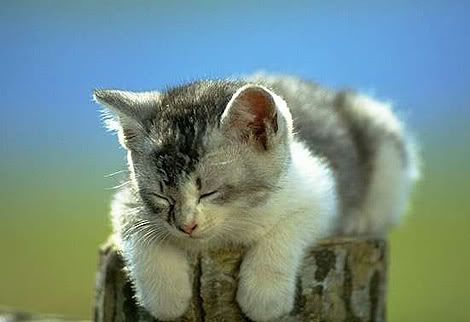
Sadly, it doesn't look like this little fellow found this interesting, either:
Unfortunately, the phenomenon I've chosen is one which, I suspect, causes some of my less-geeky readers to tune out.
You guys can scroll down to the bottom now. I'll even put in a picture of a kitten to mark the spot where I stop talking about . . . Massively Multiplayer Online Games.
By one easily found estimate, last year MMOs generated over half a billion dollars in revenue.
Initial cost for the games is minor, with an average being somewhere between $20 and $50 for the boxed version.
These retail copies exist not as sources of revenue, but primarily to bring in new gamers. Each subscription grosses the company about $180 per gamer year.
Between 2003 and 2004, the amount of subscribers has increased by 75%. At the same time, more traditional forms of entertainment (movies, record sales and (no joke) live theatre) have remained stagnant or actually declined. In some cases, the decline has prompted the RIAA to sue random people.
I've thought a lot about the appeal of these games. Not being one for self-reflection, I have tried to figure out what the other 15 million people see in them.
The first reason is clearly defined goals. In today's world, people are able to spend literally years wandering from task to task with no real purpose. In some cases, this can be enough and even financially rewarding.
For most of us, we'd like a purpose. Some computer generated guy needs 16 wolf pelts and once your character has collected them for him, he tells you that you are a better person and (in some cases) rewards your character with cash and honor. The to-do list is compelling and mostly planned out in advance. There can be a very real feeling of progress.
The second powerful component is the whole idea of playing at being someone else for a while. In fact, you can even decide what you are good at and what you look like when logged in. I think of this concept as the "Awesome You" effect.
I suspect a good number of high-level barbarian types are played by people who got beat up in gym class.
I also suspect a like number of advanced brainy spell casters are played by people who beat up nerdy kids in gym class.
In a real world where dodge ball has been banned, MMOs are the great equalizer.
So, with over $500 million in revenues, it is easy to overlook the fantasy money coming out of these games. I suspect that the government will soon stop the practice of overlooking it.
You see, most of these virtual coins a character can pick up from killing rats and pirates can be traded or sold for real, actual money. In some cases, the exchange rate is better for virtual cash (WoW gold) than for some available on currency exchanges (like the peso).
Most games will ban a player for participating in these kinds of exchanges (real world for online cash), but it is difficult to track.
Some games actively participate in it, however. Second Life, for instance, bases its entire business model around the sale of virtual money. There is still some debate over whether or not Second Life qualifies as a game.
The fact is, right now there are real people playing games and making the rent selling MMO gold for real money. There are also whole businesses based around third world MMO sweatshops where multiple people toil for currency in-game and the business owner sells it online.
Since people can tie their livelihoods into games, the rest of their lives will soon follow.
Online weddings are nothing new, but I can see the possibility that whole, legal marriages may exist between people who have never met in person. After all, "Awesome You" and "Awesome Them" can be extra awesome together online, especially without real life complications.
I can also pretty easily predict that sometime soon, someone will be prosecuted for the theft of an in-game item. I understand that in-game items don't exist in a conventional sense, but there are still some arguments to treat them as real for the purposes of theft charges.
First, the owner of the item derives joy from the ownership of the item, so the theft of that item can be defined as a loss of quality of life. The item (likely) has value out of game, and could even have been sold (against the EULA) on Ebay for actual money (minus auction fees and PayPal fees).
The counter-argument that the item is only useful in a game is compelling, but if someone steals a set of golf clubs I doubt it would hold water.
The harsh truth is that there is a lot of money and a lot of people pouring into these games, and government and even the entertainment industry will not ignore it all forever.
In fact, according to online rumors, a major studio is planning a movie based around the Lord of the Rings Online Role Playing Game.
Sadly, it doesn't look like this little fellow found this interesting, either:
Wednesday, March 07, 2007
"Because no peace is possible without a clean public restroom." - John Lennon
One year ago the first post appeared here. That post has been regularly followed by others. Some of these posts were surprisingly well received, while others faded into the archives unlamented.
This post is not to address the past year. That could be accomplished easily enough by clicking around randomly in those same archives.
Because of the focus on technology in this site, I'm going to talk about the future. Not just the future of Pr3++yG33kyTh1ng, but of the future of the world itself.
Perhaps Oscar Wilde said it best when he said, "Of all the advances mankind has made, none surpasses the idea of separate forks for the salad and the entree."
In the coming year, I plan to do even better. I hope to post more about things a person can do with a computer to improve their quality of life, especially if that means by freeing up the time to step away from the computer itself for a bit.
I'd like my work related stories to be more amusing, so I've started spiking the coffee.
Ernest Hemingway knew what he was about when he said, "The most certain thing in life is that drunks with power are both frightening and amusing," and I.T. people have more power than they should, even sober.
I plan to talk more about web culture and places and groups that I like. Everyday things happen in a virtual culture that can have profound effects on our real-life society. As Socrates once noted, "Society is a house and change is a tornado full of woodpeckers."
Finally, I plan to talk about whatever bits of current events I turn up accidentally while looking for ways to waste time online.
Pr3++yG33kyTh1ng - Year Two promises great things, and I don't intend to let this chance go to waste.
Jules Verne was known to be fond of the phrase, "The future is a jock strap made of live scorpions," and I promise, Pr3++yG33kyTh1ng - Year Two will be at least as fun as that.
Tuesday, March 06, 2007
Speaking as someone who poured coffee on his shoe from a cracked carafe this morning, Tuesday is likely going to suck.
It isn't as if every garment in my wardrobe isn't infused with rich, acidic arabica essence already, but it is the thought that even coffee, the only one who truly understands me, attempted this betrayal.
The cup I poured after correctly directing the stream seems to have little crunchy bits of something (glass?) in it, but I already added half-and-half so that it is the proper color. It would be a shame to waste it, even if the taste is rapidly becoming a tad . . . bloody.
On my way in, I varied my normal routine. I fear change, and at times this fear is justified. In fact, every time this fear is justified.
I filled my tank at the neighborhood Conoco. I suppose the cheerful 60s pop retching from the loud speakers lowered my resistance, because when prompted for a car wash, I folded like a cheap dish towel.
Do I want a car wash? Sure!
Supreme $5 car wash? Absolutely!
I wheeled my car around back and entered the sixteen digit access code. The green light beckoned me forward and I complied.
Please understand that this is the first time since I bought the car that I'd been through this process. The thick coating of highway construction grime and actual mud had left me driving the only grayish brown sport coupe I'd ever seen, or even the tortuous strains of The Mamas and the Papas would not have convinced me.
I triple checked the windows and sunroof and watched as the multi-colored foam coated the glass. I couldn't see much, but I guess the touchless wash made thirty or forty passes and finished with a wax and spot free rinse.
I drove the rest of the way to work, anxious to step out and gaze upon the sparkling glory of my car renewed.
When I arrived in the garage at work, what greeted me was not a mirror finish, but a layer of wax on top of the same grime I'd left home with this morning. And my left rear center cap had been smashed out of my still filthy wheel, shattered bits of plastic left hanging pathetically in the spring mechanism which previously held it in place.
Next time I will leave well-enough alone.
Road grime is a badge of honor my friends, and I was wrong to attempt to stash that badge like I was trying to sneak it through airport security.
Monday, March 05, 2007
Yesterday was Purim.
Gwynyth had been looking forward to dressing up. Her Disney Belle costume made for a passable Esther. In order to celebrate myself, I chose to attend in my traditional Jedi robes.
Fortunately, there were more than a few other adults who chose to dress up as well, so even dressed as a Science Fiction staple I hardly stood out.
We sang songs, watched a play and made a lot of noise every time anyone said "Haman".
Then we took a break to visit Starbucks between the service and class.
The Drive-Thru was packed, so we parked and walked in.
I ordered two (ahem) "venti breve sugar-free no-foam cinnamon dolce lattes" and discussed a variety of whole bean selections with Shana and various members of the staff.
Then Gwynyth approached the counter to watch the process.
Her arrival solicited a round of "ooohs" and "aaahs" and declarations of her cuteness.
She identified herself as Queen Esther and I said we had been to Purim.
As I stepped away from the counter with our drinks, I realized that no one had commented on my outfit.
I was dressed as a Jedi in a Starbucks on Sunday morning nowhere near Halloween and no one seemed to look twice. I tried to put myself in their shoes.
Here was the lesson I took away from this:
A seven-year-old in a princess costume is acceptable and, in fact, appreciated at just about any time of the day in just about any location.
But in a city the size of Houston, a person dressed as a Jedi at an odd-seeming time is probably crazy and likely dangerous as well. I'd avoid eye contact. Seriously, avoid eye contact.
I also learned that Gwynyth will probably never eat Hamantaschen, as apparently the act of stuffing any kind of sweet semi-liquid into a pastry disqualifies it as food to her.
Separately, pastry and sugary goo are both acceptable. Together, they are a nightmare to be avoided as though on fire, no matter how triangular and delicious they look.
Friday, March 02, 2007
I hate printers.
This is an expected side effect of my job. You see, I support an architecture where users access programs running on servers and print from those server-installed programs to their desktop-installed printers. When it works, it is awesome. When it doesn't, it is a massive pain almost impossible to troubleshoot because of the sheer number of things that could go wrong.
Since my "Paperless Office" initiative died a slow death on the desk of an Administrative Assistant, I have no choice but bravely move forward.
Back in the day, printers were less computers and more machines. There was a steel drum which (on low-speed printers) turned at 2400 RPM wrapped in a ribbon which turned at about two thirds that speed.
As the print job ran, the ribbon would slip across the surface of this drum, staying between it and the striker. Over time, the ribbon would invariably bunch towards one side, generating paper dust and friction and eventually causing paper jams.
The standard process included cleaning the whole thing with de-natured alcohol and re-installing the ribbon. You can see why so few of these beastly devices survived to make it to the computing museum. One missed cleaning or overzealous print job before the cleaning solution dried and . . . In some cases people were left with an office-less office.
The point of this story is this:
Even today, it seems that switching the setting for Printer Error Reporting to "Classic Mode" generates a standard, system-wide error for everything from "low color cartridge" to "paper tray #3 requires legal size paper." And that error is, quite frighteningly, "PRINTER ON FIRE".
"PRINTER ON FIRE" is way more frightening to management than "PC LOAD LETTER."
"PRINTER ON FIRE" generates way more questions from management than "Printer Drivers Failed to Initialize at Run Time" or "Blue Ink Low."
"PRINTER ON FIRE" causes phone calls, and my "Phone-Free Office" initiative has failed to catch on even as well as the whole paperless office thing.
Thursday, March 01, 2007
It looks like the great Daylight Saving Time move is going to destroy all hopes at productivity again today.
Apparently, appointments scheduled in the window of time between the old time change date and the new (and improved) time change are arriving at their destinations an hour early.
My test appointments for 10am are filling the 9am time slots of whoever gets them.
Applying the patch for Microsoft Outlook on my laptop moves the appointment up an hour on my calendar to match the recipient . . . And also moves their version an hour forward, allowing them to keep their edge (early bird and all) while simultaneously ensuring this meeting (were it real) would never happen.
Now, I'm all in favor of fewer meetings. However, for those members of our staff whose whole purpose seems to be the creation and attendance of various meetings this is causing quite a bit of distress.
Please understand, user distress is rarely a priority with me. Especially the mitigation of this distress. However, my boss likes to schedule meetings. And his boss likes to schedule them even more. The scheduling of meetings seems to grow in importance as one moves uphill.
Therefore, the importance of the correct functionality of the Outlook calendar rolls downhill . . . Along with various exclamation points and some bewildered-sounding profanity.
I totally blame the spotted owl.
As Dr. Phil would say, "You are only lonely if you aren't there for yourself." However, since I can only make appointments with the correct time if I am the only attendee, my tendency to skip meetings ensures that March may be very lonely indeed.
Subscribe to:
Posts (Atom)